- Operations
A complete guide to modern logistics services
A logistics company manages the movement of goods between origin and destination, and the information that travels with it. Providers are commonly grouped into four types: third-party logistics (3PL), freight forwarders, courier services and full-service providers. Freight forwarders buy space and clear customs; 3PLs hold and pick inventory; couriers move parcels; full-service providers do all three under one contract.
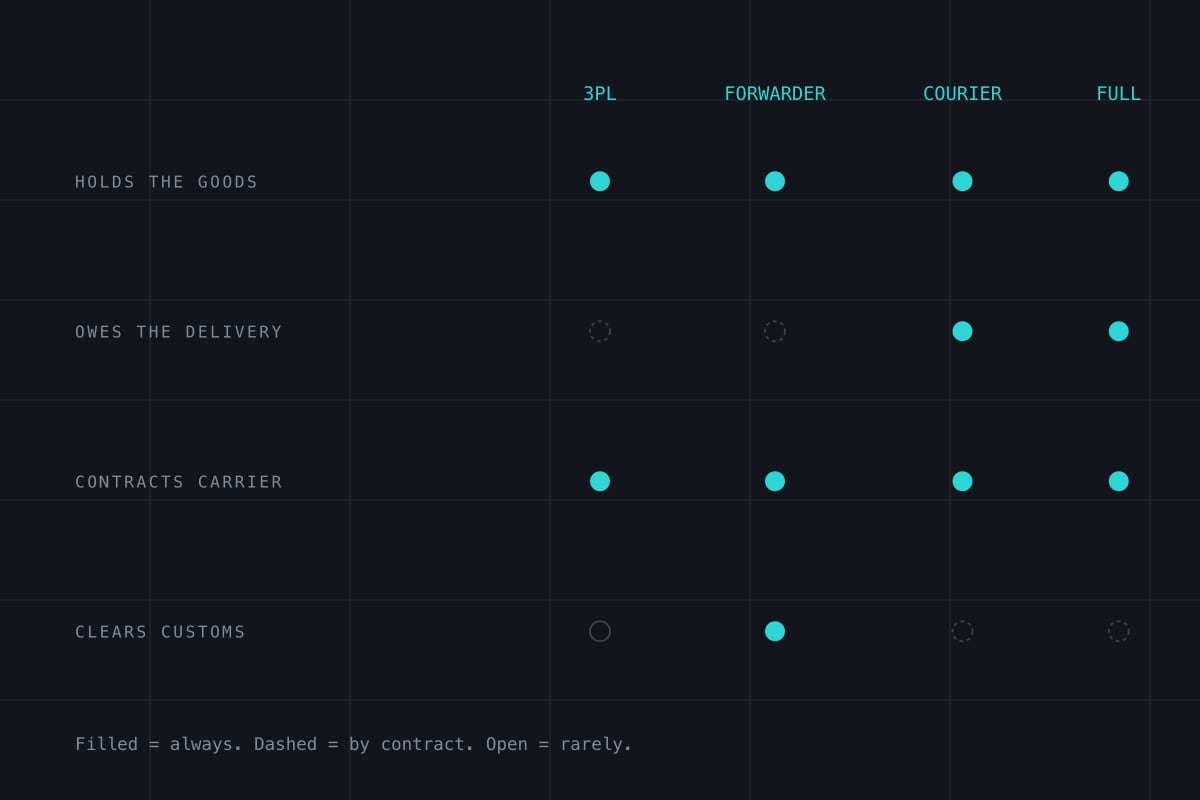
Almost every guide to logistics providers sorts them by what they are called. That is the least useful axis available, because the names overlap, the marketing overlaps more, and two companies using the same word will hand you contracts that differ on the things you will actually argue about later. Sort them instead by two questions: who is holding your goods, and who owes you the delivery. Those two answers separate the categories cleanly, they are written down in federal regulation rather than in anyone's brochure, and they decide who pays when a shipment goes wrong.
What a logistics provider actually sells
Strip the category names away and there are only three things on sale.
The first is capacity — a vehicle, a driver, a warehouse bay. A provider selling capacity is performing the movement itself and is legally on the hook for it. The second is arrangement: the provider does not own the capacity, it finds and buys it on your behalf. The third is custody and handling — receiving, storing, picking, packing, staging and loading, which is warehouse work that may or may not come with any transport at all.
Most real providers sell a mixture, and the mixture is the thing worth reading a contract for. A company that arranges transport but never takes the obligation to deliver has a very different exposure from one that accepted your freight and bound itself to move it. When a load is late, damaged or lost, that difference is the whole conversation: one party owes you a delivery, the other owes you its best efforts at finding somebody who does.
This is also why the "asset-light versus asset-based" framing you see in vendor material is not quite the right cut. Owning trucks is a balance-sheet fact. Holding the transport obligation is a contractual one, and a provider can hold it without owning a single vehicle.
The four types, and the line that separates them
| Provider type | Holds your goods | Holds the delivery obligation | Contracts the carrier | Clears customs | Typically billed for |
|---|---|---|---|---|---|
| Third-party logistics (3PL) | Yes — storage, pick, pack | Sometimes, by contract | Usually | Rarely | Storage, handling, per-order fees, freight |
| Freight forwarder | In transit and at consolidation points | Depends on whether it acts as agent or as carrier | Yes | Yes | Freight, documentation, customs entry, accessorials |
| Courier service | Yes, in its own network | Yes — it performs the movement | It is the carrier | Only on small international parcels | Per-parcel rate, surcharges, dimensional weight |
| Full-service provider | Yes | Yes, across the contracted scope | Yes, plus its own fleet | Sometimes | A blended rate per order or per shipment |
The rows that matter are the middle two. A third-party logistics provider is defined by custody: it holds inventory and works it. Whether it also owes you the delivery is a contractual choice, not a property of the category — which is why two 3PL agreements can read very differently on liability.
A courier is the simplest case. It is a carrier running its own network, so it holds the goods and the obligation together, and there is nobody in between to argue with. That simplicity is what you pay for in the per-parcel rate.
A freight forwarder is the case people get wrong. Some forwarders act as your agent — they buy space on your behalf and the carrier's contract is effectively yours. Others act as carriers in their own right, issuing their own bill of lading and buying the underlying transport themselves. The word on the door is the same. The exposure is not.
Where the legal line actually falls
United States regulation draws the distinction more sharply than most commercial contracts do, and it is worth reading once because it gives you the right question to ask.
For domestic road freight, a broker is defined as a person who, for compensation, arranges or offers to arrange transportation by an authorized motor carrier — and the same rule says that a motor carrier arranging shipments it has "accepted and legally bound themselves to transport" is not acting as a broker[broker]. That is the line: arranging is one activity, being bound to deliver is another, and one company can do both on different loads.
For ocean movement the two roles have separate names in regulation. An ocean freight forwarder dispatches shipments and arranges space on behalf of shippers, while a non-vessel-operating common carrier is a common carrier that does not operate the ships — it resells transportation it has purchased[oti]. Both are ocean transportation intermediaries; only one of them is a carrier. If your provider is an NVOCC, it has issued you a carrier's contract.
Customs is a third, separate licence. A customs broker is a person licensed to transact customs business on behalf of others, and "customs business" is defined to cover entry and admissibility, classification and valuation, and the payment of duties and taxes[customs]. A forwarder may hold that licence, may employ someone who does, or may subcontract it. It is a fair question to ask directly, because an entry filed late is a cost that lands on you.
Which one you need
The decision is easier than the category list makes it look, because it follows from your own operation rather than from the provider's.
Take a 3PL when inventory has to sit somewhere and be worked. If orders arrive in ones and twos against stock you hold, you need custody, a pick operation and a system that knows what is on the shelf. Do not take a 3PL for pure line-haul between two of your own sites: you would be paying for storage capability you never use, and adding a handover.
Take a freight forwarder when a border is involved, or when you buy capacity you cannot buy directly. Do not take one for domestic road freight you could contract yourself and already have the volume to price — you are paying an arrangement margin on a market you can reach.
Take a courier when the unit is a parcel and the network already goes there. Do not take one for anything that needs a two-person delivery, an installation, or a delivery window a customer chose: those are exception paths, and a parcel network is optimised for the absence of exceptions.
Take a full-service provider when the handovers are costing you more than the margin. Every boundary between providers is a place where information stops and blame starts. If your team spends its week reconciling three status feeds and matching them to two invoices, the case for consolidation is not the rate — it is the reconciliation. That is the same argument as running freight planning and settlement on one network rather than stitched together, and it is the reason a routing change that reaches the invoice is worth more than one that stops at the map.
Short local movements have their own vocabulary worth knowing before you price them: see what cartage covers and how drayage differs.
When you need none of them, and what this will not fix
There is a real case for keeping the work in-house, and the guides that never mention it are selling something.
Dense, repeating, local delivery. If your drops are close together, predictable and daily, your own vehicles and drivers will usually beat a network's rate and will certainly beat its exception handling. The break-even is not about volume in the abstract; it is about density.
Freight that is your product. If the delivery experience is the thing customers judge you on — installation, assembly, a two-person delivery into a room — outsourcing it puts your brand in someone else's hands and your control in someone else's system.
Where the constraint is not transport at all. If orders are late because stock is in the wrong place or the cut-off is too early, a new provider will not fix it. It will move the problem and add a monthly invoice.
What this guide does not settle. It does not tell you what any of this costs, because the answer depends on lane, density, service level and volume commitment, and any number quoted here would be a number about somebody else's freight. It also does not cover fourth-party logistics, where a provider coordinates other providers rather than performing the work — a real category, and one that only makes sense once you already run enough providers to need coordinating.
Sources
- [broker] 49 CFR 371.2 — Definitions (brokers of property) — U.S. Office of the Federal Register (eCFR). Accessed 8 September 2026.
- [oti] 46 CFR 515.2 — Definitions (ocean transportation intermediaries) — U.S. Office of the Federal Register (eCFR). Accessed 8 September 2026.
- [customs] 19 CFR 111.1 — Definitions (customs brokers) — U.S. Office of the Federal Register (eCFR). Accessed 8 September 2026.